
CONTACT: RISHABH S MEHTA, FOUNDER & CEO | LOCAD PTE LTD | SECTOR 6 TECHNOLOGIES LLP
STATUS: SCHEDULED FOR RELEASE [2026-04-03 10:00 AM]
OBJECTIVE: TECHNICAL DIFFERENTIATION OF OTS VS. LTS IN PROGRAMMATIC DOOH ENVIRONMENTS
1.0 CORE METRIC ARCHITECTURE: OTS VS. LTS
SYSTEM STATUS: [DATA SYNCING…]
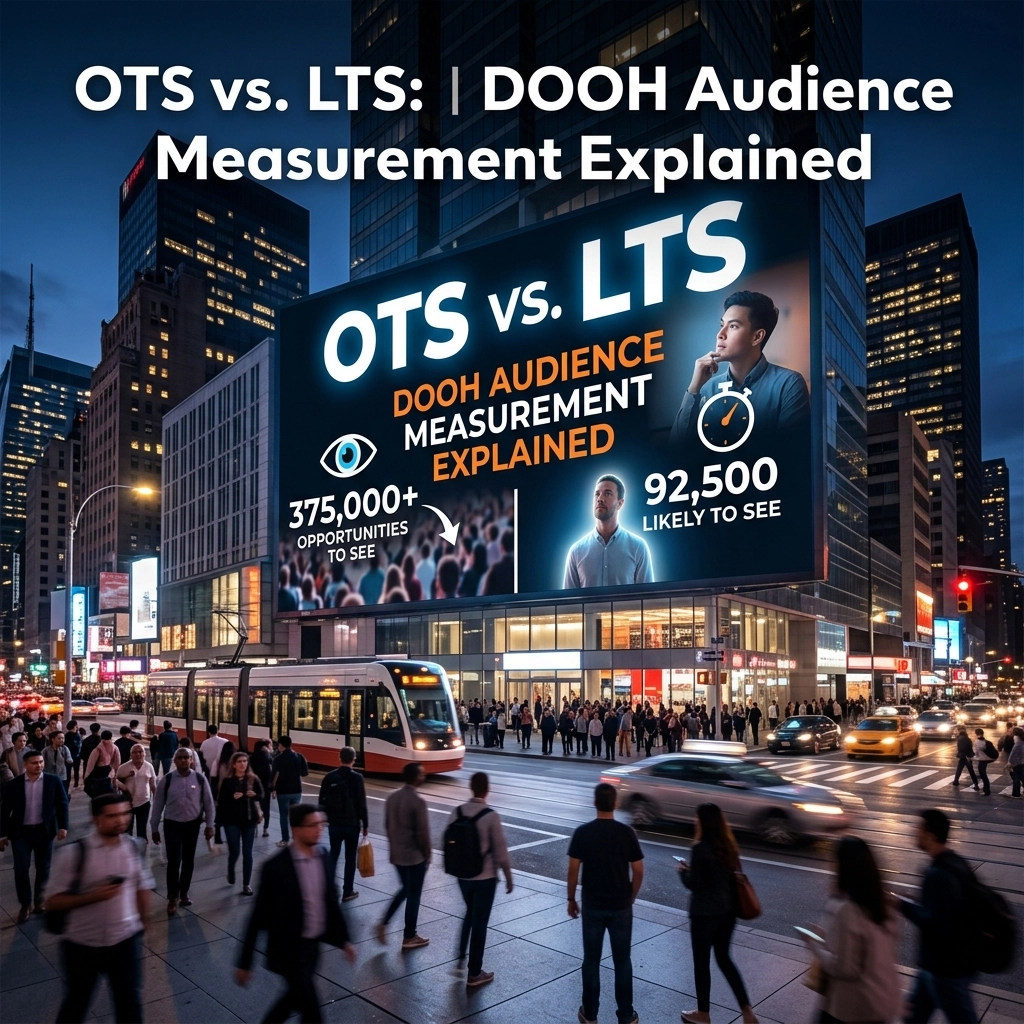
Audience measurement in Digital Out-of-Home (DOOH) utilizes two primary performance indicators to determine reach and targeting efficiency. The transition from broad traffic counts to refined visibility metrics is essential for ROI calculation and consumer engagement analysis.
1.1 OTS (OPPORTUNITY TO SEE)
- Definition: Gross potential exposure within a defined visibility zone.
- Metric Basis: Traffic intensity (Pedestrian + Vehicular).
- Calculation: Total headcount passing a specific coordinate regardless of orientation.
- Utility: Media planning, cross-channel budget allocation, gross reach estimation.
- Current Industry Status: Standardized across Global OOH Audit boards.
1.2 LTS (LIKELIHOOD TO SEE)
- Definition: Refined visibility probability based on environmental and behavioral variables.
- Metric Basis: Eye-tracking data, viewing angles, distance, and dwell time.
- Calculation: OTS x Visibility Adjustment Factor (VAF).
- Utility: Precise targeting, ROI optimization, performance-based billing.
- Current Industry Status: Emerging standard for high-accuracy programmatic DOOH.
2.0 OTS: POTENTIAL EXPOSURE PARAMETERS
[LOADING MODULE: TRAFFIC INTENSITY ANALYSIS…]
OTS represents the top-of-funnel reach metric for OOH assets. It functions as a quantitative count of all individuals with the physical possibility of encountering the advertisement.
2.1 VISIBILITY ZONE MAPPING
- Primary Zone: 0–50 meters (High impact).
- Secondary Zone: 50–150 meters (Moderate impact).
- Peripheral Zone: 150+ meters (Low impact).
2.2 DATA INPUT STREAMS
- Mobile Location Data: Anonymized SDK pings within a geofenced area.
- Historical Traffic Audits: Government-sanctioned vehicle counts.
- Sensor Aggregation: IoT-enabled pedestrian counters at transit hubs.

2.3 KEY PERFORMANCE INDICATORS (OTS-SPECIFIC)
- Gross Impressions: Total count of visual opportunities per play cycle.
- Frequency Distribution: Average number of times an individual enters the visibility zone.
- Reach Efficiency: Percentage of unique users reached within a 24-hour cycle.
3.0 LTS: REALISTIC VISIBILITY REFINEMENT
[LOADING MODULE: ATTENTION SENSOR DATA…]
LTS provides a granular view of consumer engagement by filtering OTS data through physiological and environmental constraints. It eliminates "false positives" (e.g., individuals with their backs to the screen).
3.1 VISIBILITY ADJUSTMENT FACTORS (VAF)
- Angle of Approach: Parallel (0.1 VAF) vs. Head-on (1.0 VAF).
- Screen Luminance: Nit levels vs. Ambient light conditions.
- Obstructive Logic: Buildings, foliage, or transit infrastructure blocking the line of sight.
- Movement Velocity: High-speed vehicular traffic (Lower LTS) vs. Stationary pedestrian queues (Higher LTS).
3.2 BEHAVIORAL ATTRIBUTES
- Dwell Time: Seconds spent within the optimal viewing cone.
- Gaze Duration: Milliseconds of eye-contact detected via anonymous facial detection (where permitted).
- Distraction Index: Surrounding visual noise levels (e.g., competing screens, high-density signage).

4.0 ROI CALIBRATION AND AUDIENCE MEASUREMENT
SYSTEM STATUS: [CALCULATING ROI PROJECTIONS…]
The delta between OTS and LTS significantly impacts media pricing and campaign effectiveness. Advertisers prioritizing consumer engagement utilize LTS to justify higher CPMs for premium placements.
4.1 THE CONVERSION FORMULA
- OTS / 1,000 = Gross CPM
- LTS / 1,000 = Effective CPM (eCPM)
4.2 PERFORMANCE METRICS (KPI LIST)
- Engagement Ratio: (LTS / OTS) x 100.
- Media INR+ Efficiency: Cost per actual viewer vs. cost per passerby.
- Targeting Precision: Alignment of detected audience demographics with desired campaign profiles.
5.0 LOCAD DATA-DRIVEN APPROACH: INTEGRATED ANALYTICS
[LOADING MODULE: LOCAD PROPRIETARY STACK…]
LOCAD Pte Ltd. utilizes a multi-layered verification system to provide real-time audience measurement, bridging the gap between theoretical reach and actual visibility.
5.1 REAL-TIME REPORTING TOOLS
- Dynamic Impression Audits: Live updates on audience movement.
- Heatmapping: Spatial visualization of high-LTS zones.
- Inventory Optimization: Shifting ad spend to screens with increasing Engagement Ratios.
5.2 ANALYTICS AND MAP INTEGRATION
For detailed spatial analysis and asset performance, the LOCAD dashboard provides a centralized view of both OTS and LTS metrics across regional networks.
- Reference: LOCAD Analytics and Map Interface

6.0 TECHNICAL JARGON REFERENCE & STANDARDS
[STATUS: ADMINISTRATIVE OVERVIEW]
- Impressions: Total visual opportunities served.
- Audits: Third-party verification of traffic and screen uptime.
- Programmatic DOOH (pDOOH): Automated buying and selling of OOH inventory.
- Media INR+: Value-added metric for Indian market spend optimization.
- First-Party Data Integration: Correlating OOH exposure with in-store footfall via device IDs.
7.0 DOOH AUDIENCE MEASUREMENT COMPARISON TABLE
| PARAMETER | OTS (OPPORTUNITY TO SEE) | LTS (LIKELIHOOD TO SEE) |
|---|---|---|
| Primary Variable | Traffic Volume | Viewing Probability |
| Accuracy Level | Base Level (Quantitative) | High Level (Qualitative) |
| Tech Requirement | GPS / Traffic Sensors | Eye-Tracking / Geometry Logic |
| ROI Impact | Broad Reach Estimation | Conversion Probability |
| Visibility Angle | Not factored (360°) | Factor-Dependent (Cone-specific) |
| Standard Use Case | Brand Awareness | Performance Marketing |
8.0 STRATEGIC IMPLEMENTATION CHECKLIST
SYSTEM STATUS: [READY FOR DEPLOYMENT]
- Define Objective: High Reach (OTS Priority) or High Engagement (LTS Priority).
- Site Audit: Assess physical obstructions and viewing angles of selected inventory.
- Data Sync: Integrate mobile location data with screen-level sensor logs.
- Optimization: Use LOCAD real-time analytics to reallocate budget to high-LTS slots.
- Reporting: Generate post-campaign analysis comparing OTS impressions vs. LTS engagements.

9.0 ENVIRONMENTAL & TECHNICAL CONSTRAINTS
[STATUS: LOGISTICAL DATA FEED]
- Lighting Conditions: Impact of sunlight on LTS for non-high-nit screens.
- Crowd Density: High density may increase OTS but decrease LTS due to physical blocking.
- Screen Height: Elevating screens increases visibility distance (OTS) but may alter the optimal viewing angle (LTS).
- Refresh Rates: Impact of digital creative rotation on individual viewer retention.
10.0 FINAL LOG: REACH AND TARGETING SYNERGY
[SYSTEM SHUTDOWN… DATA SAVED]
Efficiency in OOH media planning requires a dual-metric approach. While OTS provides the scale necessary for brand reach, LTS ensures the precision required for consumer engagement and verifiable ROI. LOCAD's data-centric infrastructure prioritizes the transition from potential visibility to actual audience attention.
NEXT SCHEDULED REPORT: 2026-04-06 | TOPIC: FIRST-PARTY DATA INTEGRATION
ADMINISTRATIVE NOTICE:
For further technical documentation on audience measurement algorithms or to access the real-time mapping engine, visit LOCAD Analytics.
[END OF DATA STREAM]